
Leverage is one of the most powerful concepts you can understand as a creator. It's the ability to do more with less—to multiply your effort and impact without proportionally increasing your input.
Naval Ravikant brilliantly breaks down the modern forms of leverage: code, media, and capital. Write code once, and it runs for millions of users while you sleep. Create media once—a podcast, video, or article—and it reaches thousands without additional effort. Deploy capital, and your money works for you around the clock.
These are permission-based and permissionless levers that let you scale beyond the linear constraints of trading time for money:
- A developer writes a SaaS application that serves 10,000 customers autonomously
- A content creator publishes a YouTube video that generates views for years
- An investor's capital compounds through smart allocations while they focus elsewhere
But today, we have access to what is arguably the most powerful form of leverage ever invented: Artificial Intelligence.
AI doesn't just multiply your existing capabilities—it transforms what's possible with minimal foundational knowledge. It's leverage that adapts, learns, and guides you through complex tasks you couldn't have tackled alone.
Here's what most people miss: leverage is useless without knowing where to apply it. You need just enough knowledge to position the lever correctly. Too little, and you can't use the tool. Too much, and you've wasted time learning things the leverage would have handled for you anyway.
This is where Minimum Viable Knowledge comes in—the smallest learning investment that unlocks maximum AI-powered building potential.
The idea of learning just enough to be effective isn't entirely new. Tim Ferriss explored similar territory with his meta-learning principles and "minimum effective dose" concepts. But we're living in a fundamentally different era now. What qualified as "minimum viable" knowledge in 2013 has been radically redefined by AI assistance. The threshold for what you need to know to build real, production-ready applications has dropped dramatically—but only if you know where that new threshold lies.
While this concept can apply to virtually any domain—from marketing to music production to scientific research—in this post, we're focusing specifically on coding and application development. Why? Because building software with AI assistance is one of the clearest demonstrations of how dramatically MVK changes the game.
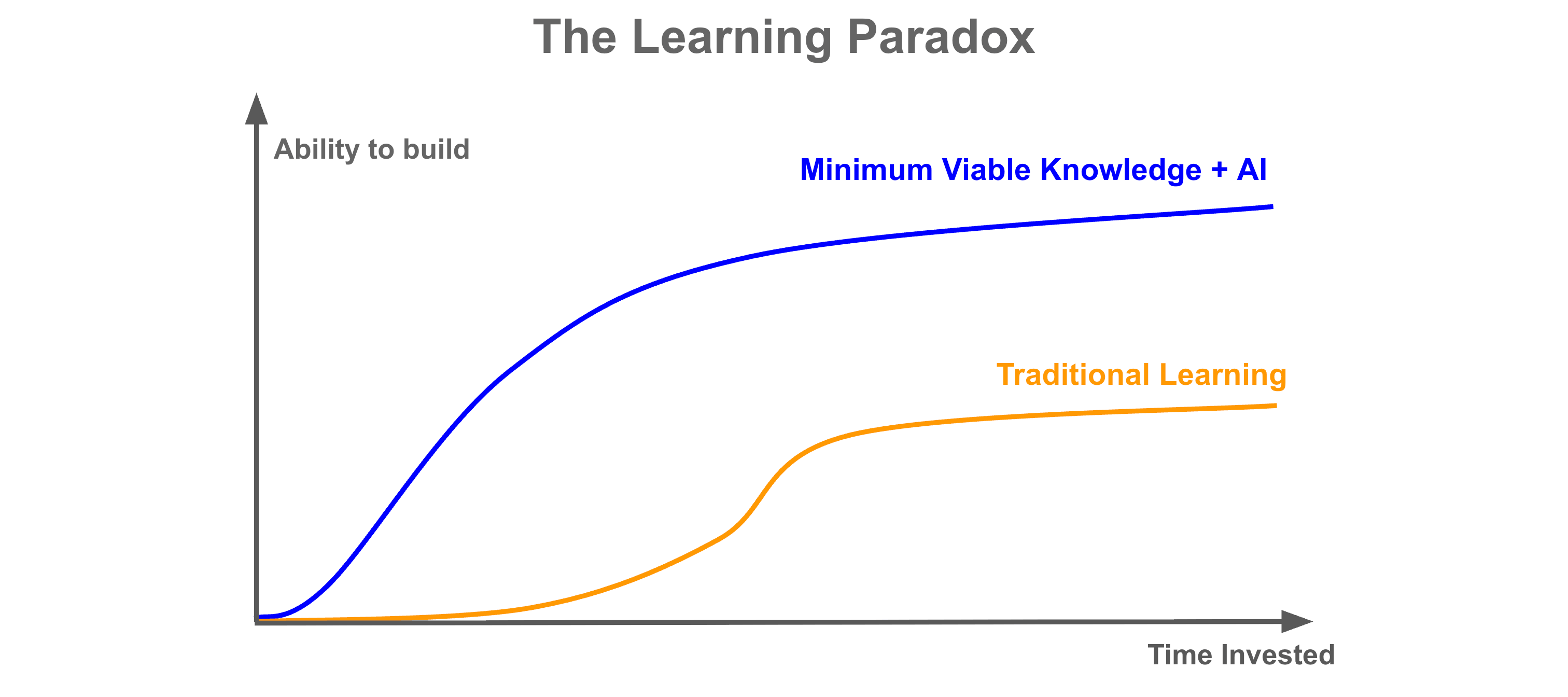
The Learning Paradox
Traditional coding education tells us we need to master everything: deep-dive into data structures, memorize syntax, understand design patterns, learn framework internals, master database optimization, and study system architecture.
The result? Aspiring developers spend months or years in tutorial hell, collecting certificates and completing courses, yet still feeling unprepared to build real applications.
But here's the paradox: in the AI era, this exhaustive knowledge is no longer the prerequisite it once was. You don't need to be a master craftsperson who knows every tool intimately. You need to be an architect who understands what's possible.
The traditional path made sense when you were building everything from scratch. But when you have an AI coding partner that knows syntax, patterns, and best practices, your role shifts from implementer to orchestrator.
What is Minimum Viable Knowledge?
Minimum Viable Knowledge (MVK) is the essential conceptual map you need to navigate a domain—the landmarks and general direction—while AI becomes your GPS guiding each step.
Think of it this way:
- Traditional Learning: Deep expertise in every component → Build applications
- MVK + AI Leverage: Essential foundations → AI assistance → Build complex applications
AI isn't replacing the need for knowledge; it's changing what type of knowledge matters. With MVK, you need to know:
- What exists (tools, frameworks, concepts)
- What's possible (capabilities and constraints)
- How things connect (relationships between components)
- What you're trying to achieve (clear problem definition)
You don't need to know the how of implementation—AI handles that. You need the what and why. AI is the lever; your MVK is knowing where to place it.
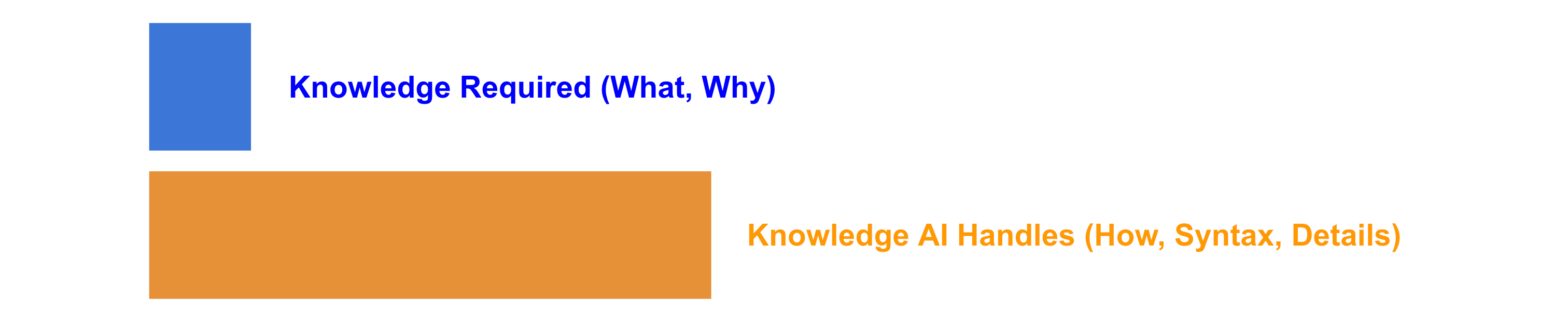
This creates a powerful feedback loop: you learn the essentials, build something real with AI assistance, encounter challenges that reveal gaps in your conceptual understanding, fill those specific gaps, and continue building. You're learning contextually, with immediate application, which is far more effective than front-loading everything.
Case Study: Building a CRUD Application
Let's make this concrete. Suppose you want to build a full-stack CRUD (Create, Read, Update, Delete) application—think a task management system, inventory tracker, or content management platform. Traditionally, this might require months of learning across frontend, backend, databases, and deployment.
What is CRUD?
CRUD stands for Create, Read, Update, Delete—the four basic operations for managing data. Almost every application you use daily (social media, email, notes apps) is built on CRUD operations.
Here's your Minimum Viable Knowledge for building a production-ready CRUD app:
What You Need to Know
| Knowledge Area | What to Understand | You Don't Need To... |
|---|---|---|
| Terminal Basics | A command line exists, you can navigate folders (cd, ls), install packages, and run scripts | Memorize commands—just know this interface exists |
| Version Control | Git tracks code changes, commits are snapshots, GitHub stores projects, basic workflow: pull → change → commit → push | Master branching strategies or Git internals |
| Programming Fundamentals | Variables store data, functions perform actions, you can import libraries, code runs sequentially | Memorize syntax—just read and understand intent |
| Framework Awareness | React/Next.js build UIs, components are reusable blocks, props pass data, state manages changes | Know framework internals or optimization tricks |
| Backend & Database | APIs connect frontend to backend, REST uses GET/POST/PUT/DELETE, databases have tables with rows and columns | Write optimized SQL queries from scratch |
| Auth & Security | Users need accounts, sessions/tokens maintain login state, never store plain text passwords | Implement cryptography—just know patterns exist |
The key insight
For each area, you need to understand what exists and why it matters—not how to implement it from scratch. AI handles implementation; you provide direction.
What AI Handles For You
| Category | AI Takes Care Of... |
|---|---|
| Syntax & Commands | Exact syntax, command flags, language-specific quirks |
| Framework Code | Boilerplate, configuration files, project structure |
| API Development | Endpoint implementation, request/response handling, routing |
| Database | Query writing, optimization, migrations, schema setup |
| Error Handling | Try/catch blocks, edge cases, validation logic |
| Security | Password hashing, token management, input sanitization |
| Deployment | Config files, environment variables, CI/CD setup |
| Styling | CSS, responsive design, component styling |
Putting It Together
With this MVK, you can effectively prompt AI to build your application:
Help me build a Next.js application with Supabase backend for managing a personal recipe collection. Users should be able to:
- Create an account and log in
- Add recipes with title, ingredients, instructions, and photos
- Edit and delete their recipes
- Search recipes by ingredient or title
- Mark recipes as favorites
I want to use Next.js 14 with the App Router and Supabase for authentication and database.
Because you understand the conceptual pieces—what Next.js is, what Supabase provides, what CRUD operations mean, how authentication works—you unlock powerful capabilities:
- Evaluate suggestions — You can tell if AI's approach makes sense
- Ask smart questions — You know what to clarify when something seems off
- Understand architecture — You see how the pieces AI builds fit together
- Debug effectively — You know where to look (frontend vs backend vs database)
- Iterate intelligently — You can request meaningful improvements
The difference
You're not blindly copying code. You're collaborating with AI as an informed partner who understands the landscape, even if you don't know every trail by heart.
Expanding the Framework: MVK Across Coding Domains
The MVK principle extends across different types of development projects. Here's what minimum viable knowledge looks like in other common domains:
Core Concepts You Need
| Concept | What to Know |
|---|---|
| Platform Options | Native (iOS: Swift/SwiftUI, Android: Kotlin) vs Cross-platform (React Native, Flutter) |
| Mobile-specific Features | Touch gestures, offline functionality, push notifications, device sensors |
| App Distribution | App stores (Apple, Google Play) have review processes and guidelines |
| Screen Sizes | Mobile screens vary significantly—responsive design is critical |
| Lifecycle States | Apps handle interrupted states (phone calls, background mode) |
What AI Handles
| Task | Examples |
|---|---|
| Platform Code | Platform-specific configurations, navigation patterns |
| Device Integration | Camera, GPS, accelerometer APIs |
| State Management | App lifecycle, data persistence |
| Build & Deploy | Configurations for both platforms |
| Performance | Optimization and best practices |
Example Prompt
Your MVK Action Plan
Ready to apply Minimum Viable Knowledge to your own projects? Follow this systematic approach:
Define Goal
Map Territory
Learn Enough
Build with AI
Iterate
Define Goal
Map Territory
Learn Enough
Build with AI
Iterate
Step 1: Define Your Goal
Be specific about what you want to build and why. Vague goals lead to vague learning.
| Goal Type | Example | Why It Works/Fails |
|---|---|---|
| ❌ Weak | "Learn web development" | Too vague—no clear endpoint or direction |
| ✅ Strong | "Build a portfolio website where I can showcase my design projects with an admin panel to add new work" | Specific outcome with clear features to build |
Step 2: Map the Territory
Identify the major components involved without diving deep into any of them yet. You're creating a mental map of the landscape.
- What are the main pieces this project needs?
- What technologies or tools are commonly used for this?
- How do these pieces communicate or work together?
Use AI to help
Ask: "What are the main components I need to understand to build [your project]?"
Step 3: Learn Just Enough
For each component you identified, seek to understand:
| Focus Area | What to Learn |
|---|---|
| What it is | The basic definition and purpose |
| Problem it solves | Why this exists instead of alternatives |
| Relationships | Where it fits in your architecture |
| Terminology | The vocabulary you need to communicate about it |
Time investment
Spend 15-30 minutes per concept. Watch a tutorial, read documentation intros, ask AI for explanations. You're building conceptual scaffolding, not expertise.
Step 4: Build with AI
Start building immediately. Use AI as your coding partner.
- Clear project context
- Specific features or functionality
- Technology choices (even if you're not sure why yet)
- Constraints or preferences
Example of effective prompting:
When you get confused
Confusion signals a gap in your conceptual understanding. Pause, ask AI to explain that specific concept, then continue building.
Step 5: Iterate and Expand
As you build, your MVK naturally expands. You're learning contextually with immediate application—the most effective form of learning.
- Build in public: Share your progress, even rough versions
- Embrace imperfection: Ship features, improve them later
- Learn from breaks: When something breaks, understand why at a conceptual level
- Pattern recognition: Notice what works, what doesn't, what's repeated
- Ask "why" not just "how": Understanding architectural decisions beats memorizing syntax
Remember
Your goal isn't to memorize everything AI teaches you. It's to gradually build mental models of how systems work together.
Common MVK Mistakes to Avoid
Mistake 1: Confusing MVK with No Knowledge
The trap
MVK isn't about skipping learning entirely. You still need foundational understanding. The difference is you're learning concepts and relationships, not implementation details.
| Approach | What It Looks Like |
|---|---|
| ❌ Wrong | Copy-pasting AI code blindly without understanding what it does |
| ✅ Right | Understanding what each piece of code accomplishes and why it's structured that way |
Mistake 2: Learning Too Much Before Building
The trap
Many developers fall into "tutorial paralysis"—consuming courses and documentation endlessly before writing a single line of code.
| Approach | What It Looks Like |
|---|---|
| ❌ Wrong | "I'll learn React completely, then Next.js completely, then databases completely, then I'll build something" |
| ✅ Right | "I'll learn just enough about React to start building, and deepen my understanding as I encounter real problems" |
Mistake 3: Not Knowing When to Level Up
The trap
Some concepts require deeper understanding than others. You'll discover these through building.
- You repeatedly encounter the same type of bug
- You can't evaluate whether AI's solutions are good or bad
- You're asking AI to fix the same thing multiple times
- You feel completely lost in a particular domain
What to do
When this happens, pause and invest focused learning time on that specific concept.
Mistake 4: Treating AI as Infallible
The trap
AI is powerful but not perfect. It can suggest outdated patterns, miss edge cases, or make architectural mistakes.
- Verify critical functionality actually works
- Test edge cases and error scenarios
- Question suggestions that seem overly complex
- Research when AI references unfamiliar concepts
- Check documentation for best practices
The New Learning Paradigm
Minimum Viable Knowledge isn't about taking shortcuts or avoiding deep learning. It's about optimizing your learning path for the AI era.
| Traditional Learning | MVK Approach |
|---|---|
| Learn everything first, build later | Learn essentials, build immediately |
| Comprehensive knowledge required | Conceptual understanding sufficient |
| Study in isolation | Learn in context of real projects |
| Prepare for years before shipping | Ship while learning, improve iteratively |
This approach aligns with how humans actually learn best:
- Context makes knowledge stick: Learning SQL while building a feature you care about is natural
- Immediate application reinforces concepts: You remember what you use
- Problem-driven learning is efficient: You learn exactly what you need, when you need it
- Building creates feedback loops: Working software tells you if you understand correctly
You're still growing
You're still becoming a skilled developer. You're still understanding systems deeply. You're still growing your capabilities. But you're doing it by building real things from day one, rather than preparing to build someday.
AI as the Ultimate Lever
Naval's Leverage Framework
Code, media, and capital let you scale beyond linear effort. AI amplifies all of these—but especially code.
With traditional development, you needed years of experience to build production applications. With MVK + AI, the timeline changes dramatically:
| Milestone | Traditional Path | MVK + AI Path |
|---|---|---|
| First real application | Years of study first | Weeks |
| Complex features | Master every technology | Build with conceptual understanding |
| Experimentation | Slow, careful iteration | Rapid prototyping |
| Learning method | Study then apply | Learn by doing |
- Ship your first real application in weeks, not years
- Build complex features without mastering every underlying technology
- Experiment rapidly with different approaches
- Learn by doing instead of by studying
This isn't about replacing developers or devaluing expertise. Deep specialists will always be crucial. But AI has democratized the ability to build and ship real software in a way that simply wasn't possible before.
The leverage equation
Your Minimum Viable Knowledge is the fulcrum. AI is the lever. Together, they let you move mountains you couldn't budge alone.
Start Building Today
The real question
The question isn't whether you know enough to start. The question is: do you know enough to ask the right questions and recognize good solutions when AI provides them?
Often, that threshold is far lower than you think.
| What You DON'T Need | What You DO Need |
|---|---|
| Master JavaScript completely | Understand what JavaScript does and where it runs |
| Know machine learning theory | Know what problem you're solving with data |
| Years of professional experience | Willingness to learn as you build |
| Perfect code from day one | Working code you can improve over time |
Ready to start? Here's a prompt template to begin your first project:
What will you build with your MVK?
You need your Minimum Viable Knowledge. You need AI as your coding partner. And you need to start building. The only question left is: what will you create?
Have thoughts on MVK or want to share what you're building? Join the discussion below or connect with other makers in the MakersHub community.